Michigan State University Press is thrilled to recognize a group of authors whose new releases have hit the ground running. From candid conversations to scientific expeditions and historical research, including contemporary essays and profoundly personal stories, MSU Press is proud to acknowledge these authors and their deeply passionate and thoughtful narratives. We want to highlight and congratulate these amazing contributors from 2025!
Matthew L.M. Fletcher
Stick Houses
As researchers tried to prompt his mother to say that her ancestors lived in wigwams or teepees, Matthew L. M. Fletcher’s mother insisted her ancestors lived in stick houses. From the opening lines of Fletcher’s story collection, he sets the scene to disrupt narrative stereotypes and expectations about how Indigenous people are perceived. He provides insight into the complex world in which Anishinaabe people live, stripped of the ownership of much of their homeland. In Stick Houses, Fletcher explores what this loss of place has meant to the Anishinaabe people of Michigan. It explores how they must leave and come back. There is dispossession and separation, but there is also reunion and restoration. These stories explore themes of home and belonging, and how Native people are not just one thing; they are both Native and non-Native blood. Some are deeply connected to their Anishinaabe heritage, while others have suffered a complete loss of their culture. Many Native people are conflicted about their background and suffer intergenerational trauma. These stories originate in dynamic environments and situations such as airports, college, Indian lawyering, and high school baseball games.
“Fletcher’s lyrical and lucid collection draws the reader into the heart and depth of each story in a multifaceted portrait of an Anishinaabe community and its people, an immersion into landscapes and lives that is a compelling and satisfying literary experience.”
—Linda Grover, professor emeritus of American Indian studies at the University of Minnesota Duluth and a member of the Bois Forte Band of Chippewa
”Come, journey into the life, the stark truths, the unbelievable circumstances that Native Americans contend with on a daily basis. Fletcher has opened up our universe to allow you, the reader, a chance to share the usually unspoken.”
—Louis V. Clark III (Two Shoes), author of How to Be an Indian in the 21st Century and Rebel
Edited by Inés Hernández-Ávila and Molly McGlennen
Indigenous Poetics
Indigenous Poetics is a collection of essays by contemporary Native American poets in the United States who explore how the genre helps to radically understand, contemplate, and realize something deeper about ourselves, our communities, and our worlds. The collection illuminates the creative process, identity, language, and the making of poetry. The contributors tell us, in their own words and on their own Indigenous terms, how they engage poetic expression as one would a tool, a teacher, a guide, a map, or a friend. Indigenous Poetics reveals poetry’s crucial role in the flourishing of Native American and Indigenous Studies.
Molly McGlennen was born and raised in Minneapolis, Minnesota, and is of Anishinaabe and European descent. She earned a PhD in Native American studies from University of California–Davis and an MFA in creative writing from Mills College. Currently, she is a professor of English and Native American studies as well as the Anne McNiff Tatlock ’61 Chair in Multidisciplinary Studies at Vassar College, where she has been responsible for building its Native American Studies program. McGlennen is the author of two collections of poetry, and her poems appear in Poetry, Academy of American Poets’ Poets.org (Poems-a-Day), Red Ink, Yellow Medicine Review, Prairie Schooner, and Sentence. Her critical monograph Creative Alliances: The Transnational Designs of Indigenous Women’s Poetry earned the Beatrice Medicine Award for Scholarship in American Indian Studies. From 2020–23, McGlennen served as president of the Association for the Study of American Indian Literatures.
Inés Hernández-Ávila is Niimiipuu (Nez Perce) and Tejana (Texas-Mexican). She is a poet, visual artist, and professor emerita of Native American studies at University of California–Davis and one of the six founders of the Native American and Indigenous Studies Association (NAISA). She collaborates with the Library of Congress, Palabra archive, working to increase the recordings of Indigenous creative writers from Latin America. She is a member of Luk’upsíimey/The North Star Collective, which promotes Niimiipuu language revitalization through creative writing. A recent publication (poems and an essay) appeared in the anthology The Shared Language of Poetry: Mexico and the United States. She contributed poems to wiic’íiqin hitoláaycix / “words going upriver” / palabras yendo rio arriba: Poesía de [Poetry from] Luk’upsíimey: The North Star Collective, a chapbook given to Mayan writers in Chiapas in 2022.
Candid Conversations on a Changing Northern Michigan
What happens when a place is so beautiful that everyone wants to go there—and then they stay? This book explores a phenomenon occurring around Michigan’s Great Lakes and other high-demand scenic locations across the country: natural landscapes are undergoing profound human and climatological change as people pick up their lives and move to bucolic locations. The Grand Traverse region in northwest lower Michigan has been one of the most impacted regions in the state, with the population increase accelerated by the pandemic and climate change. The impact of this growth is explored through field observations and interviews involving dozens of born-and-raised locals, “boomerangers” (those who grew up, left, then returned), and relocators. The author explores the tensions between newcomers and “natives.” Interviewees include tourist industry leaders, conservationists, business owners, public safety officials, tribal members, Sleeping Bear Dunes National Lakeshore officials, and more. These voices characterize the region’s diverse views, providing insight into how one of the most popular vacation destinations in the country is attempting to balance environmental preservation with an influx of people. Northwest lower Michigan’s story of transformation, as tradition collides with progress, holds many lessons and will resonate with everyone who has ever lived in or visited such an enchanting place and dreams of calling it home.
“This Magnetic North is a deep conversation about Northern Michigan and the ever-increasing pressure of climate change and migration coupled with the intensifying, almost tectonic force of tourism. This book is an odyssey to be savored and taken in. It is essential reading for anyone who claims to love Northern Michigan for its beauty.”
—Michael Delp, author of The Mad Angler: Poems and coeditor emeritus of the Made in Michigan Writers Series
“Tim Mulherin’s book This Magnetic North offers a thoughtful, curious, and whimsical window into our up-north paradise, and how the pandemic, climate change, and our robust – some would say “too robust”-tourism marketing network has changed the human experience in the Leelanau and Grand Traverse region.”
—Jacob Wheeler, editor and publisher of the Glen Arbor Sun, and journalism instructor at Northwestern Michigan College
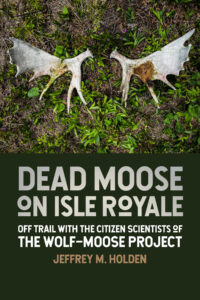
Off Trail with the Citizen Scientists of the Wolf-Moose Project
Isle Royale in Michigan is one of the most remote and pristine of all the U.S. national parks, and it is the site of the world’s longest-running predator–prey study. Every summer, Jeffrey M. Holden leads groups of citizen scientists on week-long expeditions to search for dead moose. Those intrepid enough to join him backpacking off trail in Isle Royale’s rugged beauty face challenges from treacherous weather conditions, to wildlife, primitive backcountry camping, traveling through swamps and wetlands, and backpacks that grow heavier with bones every time a new dead moose is found. Sometimes the moose they find are long dead, with only a scattering of bones remaining. Sometimes they are freshly departed, rotted, stinking, and covered with thousands of bloodthirsty ticks. Scientists use the bones, photos, and data they collect to reconstruct the moose population through the years, correlating it against other data on wolves, weather, and ticks. This book provides a fascinating look into the day-to-day realities of backpacking in the wilderness, while featuring the extraordinary scientific discoveries of the Wolf-Moose Project itself and highlighting the role and rewards for volunteers in this extraordinary endeavor. This is a must read for anyone who is interested in off-trail hiking, becoming a citizen scientist, or exploring America’s least-visited national park.
“Steeped in science, the Isle Royale wolf-moose study is the most famous carnivore study in the world. There is no loss for written material on this project. Yet, Jeffrey Holden has done just that, given us more and up close and personal view from a non-scientists perspective on what it takes to keep such a study going and offering year-after-year of amazing insights into how nature works. A seasoned hiker and Isle Royale enthusiast, Holden takes us on a rare journey through nature, science, and how we learn about the natural world.”
—Douglas W. Smith, Senior Wildlife Biologist, Yellowstone National Park (retired)
“In a wide-ranging book based on a couple of decades of tramping for science in Isle Royale National Park, Jeff Holden’s book is a treasure. With ample wit, humor, and insight, Holden regales the reader with real-world adventures, great stories, and humble recounting of inevitable foibles. It becomes obvious that after a week of ‘in-tents’ togetherness in the bush, a group of strangers can blossom into tight-knit camaraderie, all the while providing valuable contributions as citizen-scientists.”
—Rolf O. Peterson, author of The Wolves of Isle Royale: A Broken Balance
The Edmund Fitzgerald and the Sinking of the American Economy
Wrecked links the story of America’s most infamous shipwreck to the story of an even larger disaster—the wreck of the American industrial economy. When the Edmund Fitzgerald went down in a Lake Superior storm on November 10, 1975, more was lost than the ship and the twenty-nine lives on board. The disaster was a human tragedy as well as an indictment of the American industrial policies that eventually cost the nation thousands of jobs and marooned hundreds of communities. Written with a passionate yet factually grounded intensity, Wrecked shows that the reasons for the decline of industrial manufacturing in the upper Midwest are linked to why the Edmund Fitzgerald sank, and to the legal turmoil that followed for the victims’ families. The book conveys the sense of loss that still is felt by those affected, along with the outrage over the disappearance of manufacturing jobs and the inadequate maintenance and legal maneuvering over liability for the sinking of the ship. What follows is a fascinating critique of what went wrong and why.
“Over the last forty years, the United States has undergone wrenching transformations—deindustrialization, declining unionization, and rising inequality—which have coincided with increasingly dysfunctional politics. Thomas Nelson masterfully marries this narrative to that of the infamous sinking of the USS Edmund Fitzgerald on Lake Superior in 1975. This provocative new book unites a compelling narrative of the accident and its social aftermath with a powerful call for the rebuilding the U.S. industrial base.”
—Nolan McCarty, Susan Dod Professor of Politics and Public Affairs, Princeton University
“Lovers of Gordon Lightfoot’s ballad ‘The Wreck of the Edmund Fitzgerald’ will read Wrecked to find out what actually happened to both the ship and its individual crew members. Thomas Nelson and Jerald Podair succeed in intertwining this tale with a bigger and equally heart-wrenching story: the disappearance of American manufacturing, the rusting and decline of unions, the disintegration of infrastructure and safety standards, and the abandonment of American workers.”